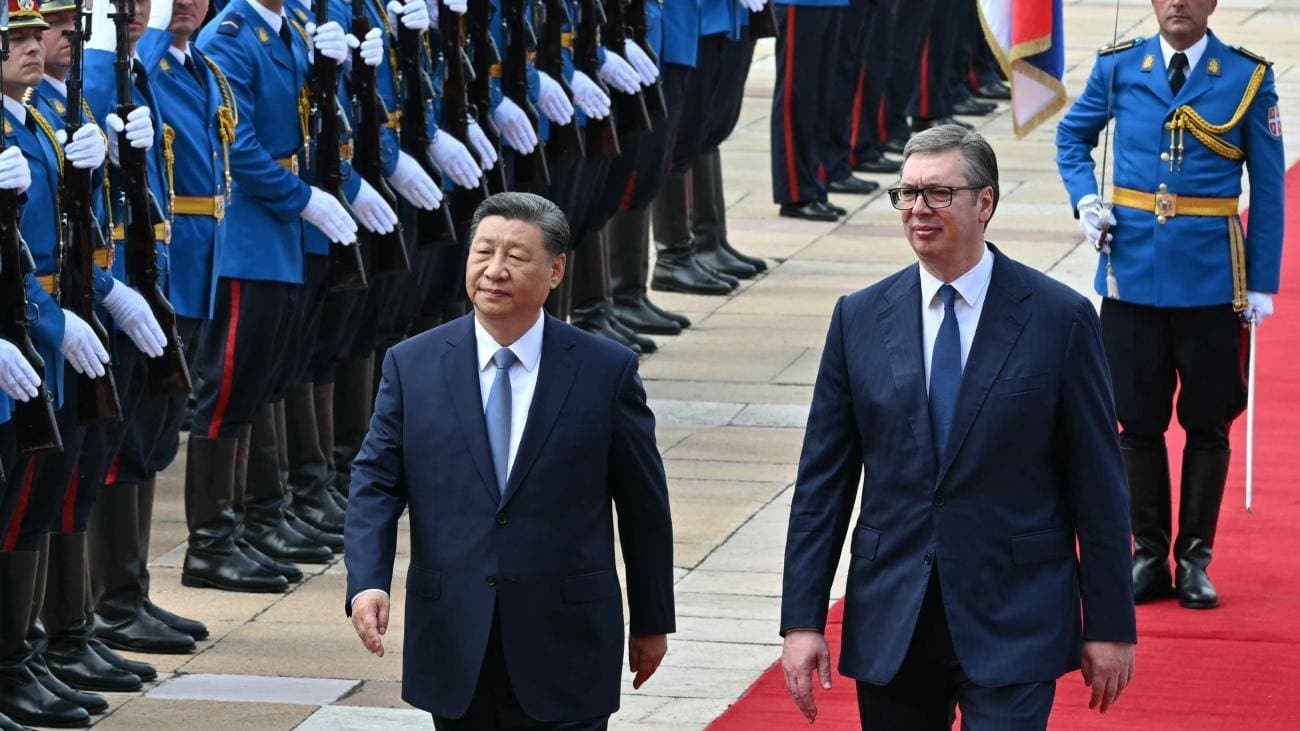
During President Xi Jinping’s trip to Europe this week, he must have discovered some parts of Europe have become an entirely different place since his visit five years ago.
Gone are the heydays of economic globalization, when China was viewed as an indispensable investment destination. Instead, the mood among European leaders is to ‘de-risk’ – moving investments and supply chains away from the world’s second largest economy.
Judging from his statements in Paris, Beijing’s assessment of Europe has also shifted. This is certainly a renewed charm offensive, hoping to tempt Europeans to continue to invest in China.
But equally Xi gave the EU tough warnings on Europe’s trade protectionism and its current diplomatic stance. In his own words, he expects ‘EU institutions to have a correct view on China’ which is an unprecedented line for China to take on the EU.
Despite a sense of bonhomie from all three countries he is visiting, it will be far from straightforward to effect a reconciliation on either the economic or diplomatic fronts. This is largely due to the development of China and Europe’s domestic politics and economies – and the ongoing war in Ukraine.
The main purpose for Xi’s European tour is therefore damage limitation, preventing ties with Europe worsening even more, as they have with Washington. He is also seeking to exploit divisions within Europe on Ukraine and US relations, working towards China’s vision of a more multipolar world.
Economics
On economic matters, China has decisively pursued industrial policies that will enable Beijing to move up the export value chain and establish itself as a high-end manufacturing powerhouse: instead of producing cheap toys, Beijing wants to lead exports of electric vehicles, lithium batteries and solar panels.
This is also the moment where the Chinese economy is at a painful, if necessary, transition, changing its growth model from an over-reliance on the property sector into counting on high value-added manufacturing exports. Europe will be a critical market for those goods.
But Chinese companies are also in brutal competition with European peers, both in Europe and developing countries, partly boosted by state subsidies.